

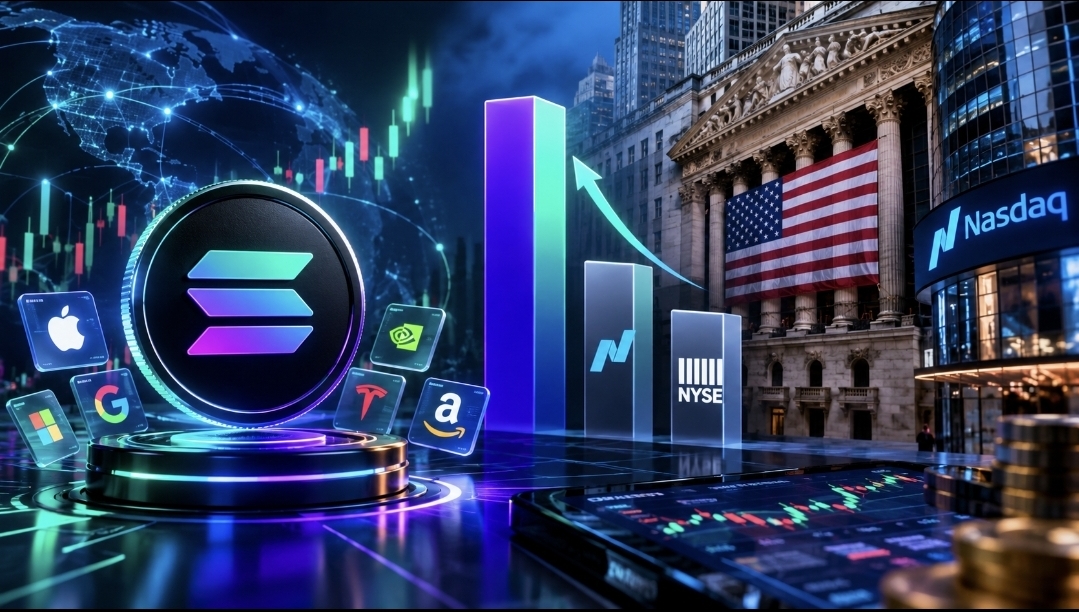
Solana recorded more than $100 million in additional tokenized equity trading volume than the Nasdaq and New York Stock Exchange (NYSE) combined in the latest daily comparison, highlighting the rapidly growing demand for blockchain based stock markets. The milestone adds to Solana’s expanding role in real world assets (RWAs), as investors increasingly use blockchain networks to access tokenized versions of traditional equities.
The reported surge comes as tokenized stocks gain momentum across crypto markets, allowing investors to trade representations of public company shares on blockchain infrastructure. Unlike traditional stock exchanges, blockchain based markets can support trading around the clock, potentially giving investors access to equity markets outside conventional market hours.
The development also arrives during a broader push toward tokenized financial markets. Solana’s tokenized equity supply recently reached a record $684 million, increasing 47% in just three weeks, according to data highlighted by Solana.
Solana’s Tokenized Equity Market Gains Momentum
The latest volume comparison demonstrates how quickly tokenized equities have expanded on Solana. Tokenized stocks allow blockchain users to gain exposure to traditional equities through digital representations that can move across decentralized and crypto native financial infrastructure. This creates a bridge between traditional finance and decentralized finance (DeFi), while opening new possibilities for global and 24/7 equity trading.
Solana has emerged as one of the leading blockchain networks for tokenized equities, supported by high transaction capacity, low transaction costs and an expanding ecosystem of trading applications. Earlier data showed the network processing billions of dollars in tokenized equity activity, with Solana accounting for a dominant share of tokenized stock trading across blockchain networks.
The growth is also being supported by products from companies building tokenized versions of recognizable public equities. Tokenized equity platforms can allow eligible users to trade digital representations of stocks outside traditional exchange hours, although access, ownership rights, jurisdiction and regulatory protections can differ significantly from conventional share ownership.
Wall Street Moves Deeper Into Tokenization
Solana’s latest milestone comes as traditional financial institutions increasingly embrace blockchain based market infrastructure. Nasdaq announced a $100 million investment in Payward, the parent company of Kraken, as part of a broader collaboration focused on tokenized equities and blockchain powered trading infrastructure.
Nasdaq’s move illustrates the changing relationship between traditional exchanges and crypto infrastructure. Rather than treating blockchain markets solely as competition, major financial institutions are increasingly exploring tokenization as a way to expand trading hours, improve settlement infrastructure and distribute financial assets through digital networks.
Nasdaq has also been working with Kraken on technology designed to support tokenized equities while maintaining traditional market safeguards. The partnership is expected to focus on areas including trading, distribution and post trade infrastructure, reinforcing the broader financial industry’s interest in blockchain based securities markets.
24/7 Stock Trading Could Reshape Equity Markets
The Solana milestone highlights a fundamental difference between blockchain based equity markets and traditional stock exchanges: operating hours. Tokenized equities can potentially trade continuously, including during weekends and outside the standard sessions operated by exchanges such as Nasdaq and NYSE.
Recent market data has already shown substantial demand for this model. Tokenized equities across major blockchain networks generated more than $1 billion in trading over a weekend when traditional U.S. stock markets were closed, demonstrating that investors are increasingly willing to trade equity linked assets outside conventional market hours.
However, tokenized equity volume should not automatically be interpreted as equivalent to conventional stock market volume. The underlying assets, trading venues, liquidity structures, investor eligibility and legal rights can differ between tokenized products and shares traded directly on regulated exchanges. The latest comparison therefore represents an important signal for blockchain adoption, but it does not mean Solana has replaced Nasdaq or NYSE as a traditional equity exchange.
Still, the growing activity strengthens Solana’s position in the tokenization race. With tokenized equity supply reaching record levels and traditional financial institutions investing in blockchain infrastructure, the market is moving toward a future where stocks and other real world assets can operate alongside crypto assets on always on financial networks.