

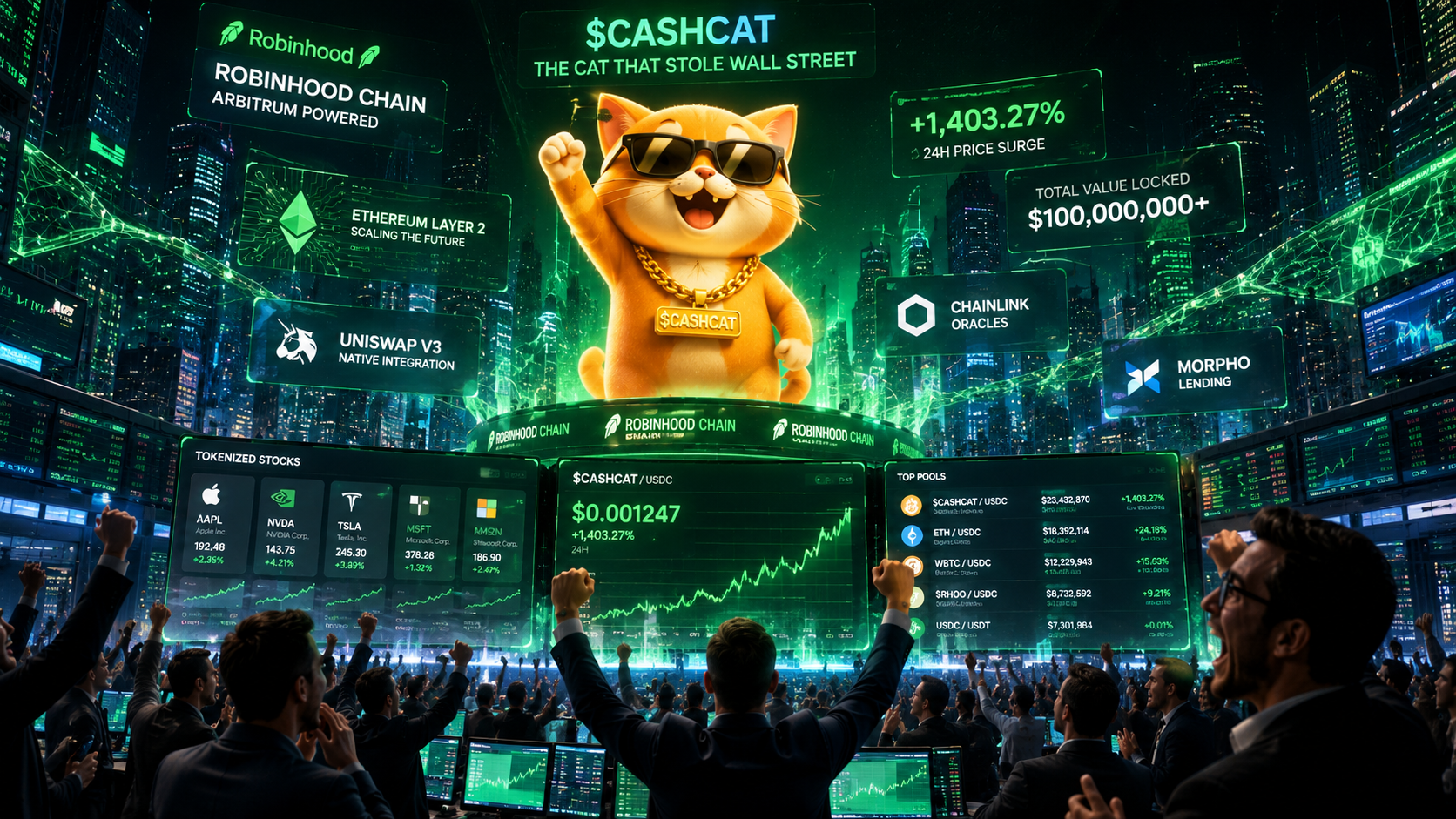
Robinhood’s newly launched Ethereum Layer 2 network is already witnessing its first viral crypto phenomenon, as the community-driven memecoin CASHCAT surged to a peak market capitalization of nearly $150 million just days after the blockchain went live.
The explosive rally highlights how quickly permissionless ecosystems can develop their own narratives, even when their creators have entirely different ambitions.
Robinhood introduced Robinhood Chain during its “The World Is Flat” event in London on July 1, positioning the Arbitrum-powered Layer 2 as infrastructure for tokenized stocks, decentralized finance (DeFi), AI-native applications, and on-chain investing.
Instead, the network’s biggest early success has been a cat-themed memecoin.
CASHCAT Becomes Robinhood Chain’s First Viral Token
Launched quietly without a major marketing campaign, CASHCAT quickly captured the attention of crypto traders after users connected the project to an abandoned cat mascot reportedly used during Robinhood’s early development.
The token’s community-driven momentum rapidly spread across social media, drawing thousands of traders eager to participate in the newest ecosystem.
Within days, CASHCAT recorded gains exceeding 1,400% at its peak, while reports suggested some early investors turned modest positions into life-changing profits as trading volume accelerated.
Robinhood Chain Sees Explosive On-Chain Activity
The memecoin rally also helped fuel rapid growth across Robinhood Chain.
According to ecosystem data, decentralized exchange activity surged as liquidity providers and traders poured into the network.
Early metrics reportedly showed:
- Daily DEX trading volume surpassing $500 million
- Total Value Locked (TVL) climbing above $100 million
- Significant liquidity flowing into lending protocols
- Thousands of new wallet holders joining the ecosystem
The sudden influx of activity demonstrated how speculative trading can accelerate adoption during the early stages of a blockchain launch.
Wall Street Meets Crypto Culture
Robinhood originally positioned its blockchain as infrastructure for regulated financial products.
The network launched with support for:
- Tokenized stocks
- 24/7 perpetual futures trading
- Native Uniswap integration
- Chainlink oracle services
- Morpho lending protocols
- AI-ready blockchain infrastructure
However, the emergence of CASHCAT illustrated a familiar pattern within crypto markets: community narratives often develop independently of a project’s original vision.
The contrast between institutional finance and internet meme culture quickly became one of the chain’s defining stories.
Memecoins Continue to Drive Ecosystem Growth
Robinhood Chain’s early experience mirrors previous blockchain launches where memecoins played a significant role in attracting liquidity and users.
Many traders migrated from other ecosystems in search of new opportunities, taking advantage of low transaction fees and Robinhood’s large retail user base.
Industry observers note that while memecoins often introduce heightened volatility, they can also accelerate developer activity, liquidity formation, and broader ecosystem awareness.
Volatility Remains a Risk
As with many rapidly appreciating memecoins, CASHCAT experienced significant price swings following its initial rally.
The project faced speculation, wallet concentration concerns, and allegations commonly associated with newly launched tokens.
Despite the volatility, trading activity remained elevated, and Robinhood Chain continued attracting users beyond the initial wave of speculative trading.
What Comes Next?
Robinhood’s long-term vision extends far beyond memecoins.
The company continues building infrastructure focused on tokenized real-world assets, decentralized finance, AI-powered financial applications, and blockchain-based investing.
Nevertheless, CASHCAT’s rapid rise demonstrates an enduring truth about cryptocurrency markets.
Even the most sophisticated blockchain infrastructure can be defined by unexpected community-driven narratives.
For Robinhood Chain, the first breakout application wasn’t tokenized Wall Street.
It was a cat.