


After losing approximately $40,000 through trading, Tanishq Saluja began building Glavior around a simple idea: market intelligence should be filtered before reaching traders and recorded before the outcome is known.
Crypto traders have never had access to more information.
Every market movement now produces thousands of posts, price predictions, Telegram calls, influencer opinions, indicators, alerts, and supposedly profitable trading systems.
Yet for many retail traders, this abundance of information has not resulted in better decisions.

For Tanishq Saluja, the 16-year-old founder of Glavior, it produced the opposite.
By the age of fifteen, Saluja had generated approximately $40,000 across online businesses, freelancing, and trading. He subsequently lost approximately the same amount through trading.
The losses did not come from one catastrophic position or one dramatic market collapse. They accumulated through Telegram calls, influencer recommendations, fear of missing out, emotional trading, overtrading, revenge trading, and the constant pressure to act on incomplete information.
“Every loss looked different when it happened,” Saluja said. “But when I stepped back, the underlying problem was almost always the same. There was too much information and not enough filtering.”
That realization became the foundation for Glavior.
From More Signals to Better Decisions
Most retail trading products are designed to give users more.
More charts. More indicators. More alerts. More market commentary. More potential trades.
Glavior is being built around the opposite assumption: most market opportunities should be ignored.
At the core of the platform is Pegasus, Glavior’s proprietary market-analysis model. Pegasus evaluates areas including market structure, liquidity, order flow, derivatives data, momentum, volatility, news, on-chain activity, chart formations, and risk.
Its purpose is not to force a trading signal from every market condition. It is designed to reject weak opportunities and produce a complete trade plan only when a setup passes the platform’s decision and validation process.
When an opportunity qualifies, the system can provide a directional view, entry area, stop loss, take-profit levels, risk-to-reward information, confidence, and the reasoning behind the decision.
“The real edge is not finding more signals,” Saluja said. “It is knowing which ones deserve your attention.”
This distinction is important in an industry where engagement is often rewarded more than accuracy.
Influencers and signal providers are incentivized to post constantly, even when the market does not offer a high-quality opportunity. Every prediction creates another piece of content, another screenshot, and another chance to capture attention.
A platform that frequently says no may produce fewer signals, but it may also prevent users from taking unnecessary trades.
Crypto’s Track-Record Problem
Filtering opportunities solves only part of the problem.
The second issue is accountability.
Crypto traders are surrounded by performance claims that are difficult to verify. Winning screenshots can be published after prices move. Losing calls can be deleted. Entry levels can be changed retrospectively. A few successful positions can be presented publicly while failed predictions disappear.
Glavior attempts to address this through its publicly accessible performance ledger.
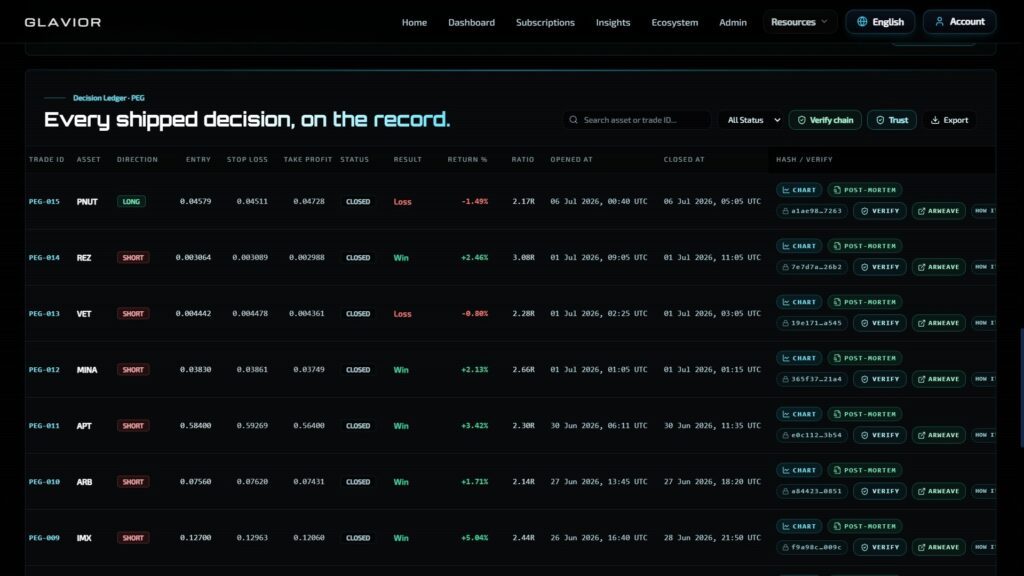
Every official Pegasus analysis is recorded before the outcome is known. The records are organized into a hash-chained ledger and cryptographically anchored using Bitcoin OpenTimestamps and Arweave.
Readers can inspect the separate public records for Pegasus v1 and Pegasus v2.
The goal is to make it possible for users to determine when an analysis was produced and whether its historical record was modified or selectively removed after the market outcome became visible.
Completed trades are also accompanied by public postmortems explaining the original reasoning, what occurred in the market, and how the setup ultimately performed.
“No edits, no deletions, and no hindsight,” Saluja said. “If a system wants people to trust its performance, it should preserve the failures alongside the wins.”
This approach does not guarantee that future analyses will be profitable. It does, however, make the historical record more difficult to manipulate.
That is a meaningful distinction in a sector where traders are regularly asked to trust anonymous operators, private communities, and selectively presented results.
An Early Public Production Record
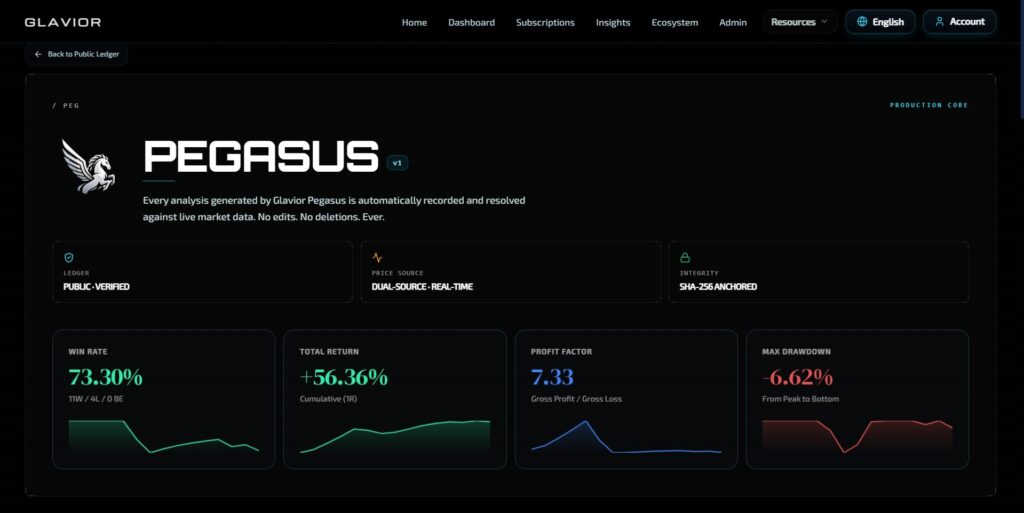
Following the public ledger’s launch on June 23, Pegasus v1 completed an initial production run of 15 official signals by July 6.
The recorded results included 11 winning trades and four losing trades, representing a 73.3 percent win rate.
Using Glavior’s standardized 1R evaluation basis, the run recorded:
- A 56.36 percent cumulative return
- A 7.33 profit factor
- A 2.57-to-1 average risk-to-reward ratio
- A 6.62 percent maximum drawdown
The complete entries remain available through the Pegasus v1 Public Ledger.
The sample remains limited and should not be interpreted as proof of permanent or long-term profitability. Saluja describes it as an initial public production record rather than final validation of the model.
Its significance, he argues, is that the analyses were published before their outcomes and remain available for independent inspection.
Pegasus v2 has since gone live with changes to its inference, calibration, validation, decision, and execution pipeline. Its developing record can be followed separately through the Pegasus v2 Public Ledger.
Glavior is now entering a controlled beta intended to generate broader usage data and test whether its technical results translate into retained customer value.
Traders, investors, creators, and potential distribution partners can apply for Glavior Beta access.
Execution Without Custody
Glavior is not limited to producing market analysis.
The platform can connect to a user’s own exchange account through APIs and execute approved trading plans without taking custody of the user’s funds.
This model is intended to separate automation from custody. Users retain their assets in their own exchange accounts while Glavior provides the intelligence and execution layer.
The platform also includes on-demand market research, paper trading, portfolio tools, chart and candlestick pattern detection, and whale intelligence.
It currently supports 18 languages as part of an effort to make the platform accessible beyond English-speaking markets.
Saluja says the long-term ambition extends beyond cryptocurrency.
Glavior is beginning with crypto, the market he understands most directly, but plans to expand into equities, forex, commodities, and other global financial markets.
The broader goal is to become an intelligence layer people consult before making financial decisions, rather than simply another place where they receive trade alerts.
Built From Direct Experience
Saluja’s path into technology did not begin with Glavior.
He started looking for ways to earn online at nine. At twelve, he founded TSS Market, an online business selling digital products and services to customers internationally.
He independently handled product creation, customer acquisition, outreach, marketing, payments, support, and daily operations until 2024.
He started trading financial markets at thirteen.
The money he later lost through trading became both the financial cost of the problem and the reason he understood it closely enough to begin building a solution.
Saluja started exploring the idea behind Glavior in February 2025 and began serious full-product development in October of that year.
After completing Class 10, he chose to leave school and work on the company full-time.
He has built the platform without a co-founder, employees, or outside investment.
The frontend, backend, database architecture, AI-assisted market-analysis workflows, infrastructure, deployment systems, public ledger, portfolio tools, and non-custodial execution infrastructure were developed by Saluja through AI-assisted research, repeated experimentation, and live-market testing.
The company is now preparing to turn its completed product and early technical validation into measurable commercial validation and a repeatable distribution engine.
Proof Before Promises
Crypto does not suffer from a shortage of predictions.
It suffers from a shortage of systems willing to show exactly what they predicted, when they predicted it, and what happened afterward.
Glavior is an early attempt to build that accountability directly into the product.
Its future will depend on more than an initial set of performance results. The platform still has to prove that traders will use it repeatedly, connect exchange accounts, pay for access, and make better decisions over time.
But its founding argument is increasingly difficult to dismiss.
Retail traders do not need another endless stream of opportunities.
They need stronger filters, transparent reasoning, and evidence that existed before the result.
For Saluja, the approximately $40,000 he lost was the price of discovering that difference.
Glavior is his attempt to make sure the next trader does not have to learn it the same way.
Explore Glavior
Visit the Glavior platform, inspect its public performance ledger, compare the records of Pegasus v1 and Pegasus v2, or apply for beta access.
About Tanishq Saluja
Tanishq Saluja is the 16-year-old founder and CEO of Glavior, a financial intelligence and non-custodial execution platform built around filtered market analysis and publicly verifiable performance.
He began earning online at nine, founded his first internet business at twelve, started trading at thirteen, and began building Glavior after his experience with trading noise, emotional decision-making, and unverifiable information.
Follow Tanishq on LinkedIn, X, and Instagram.