

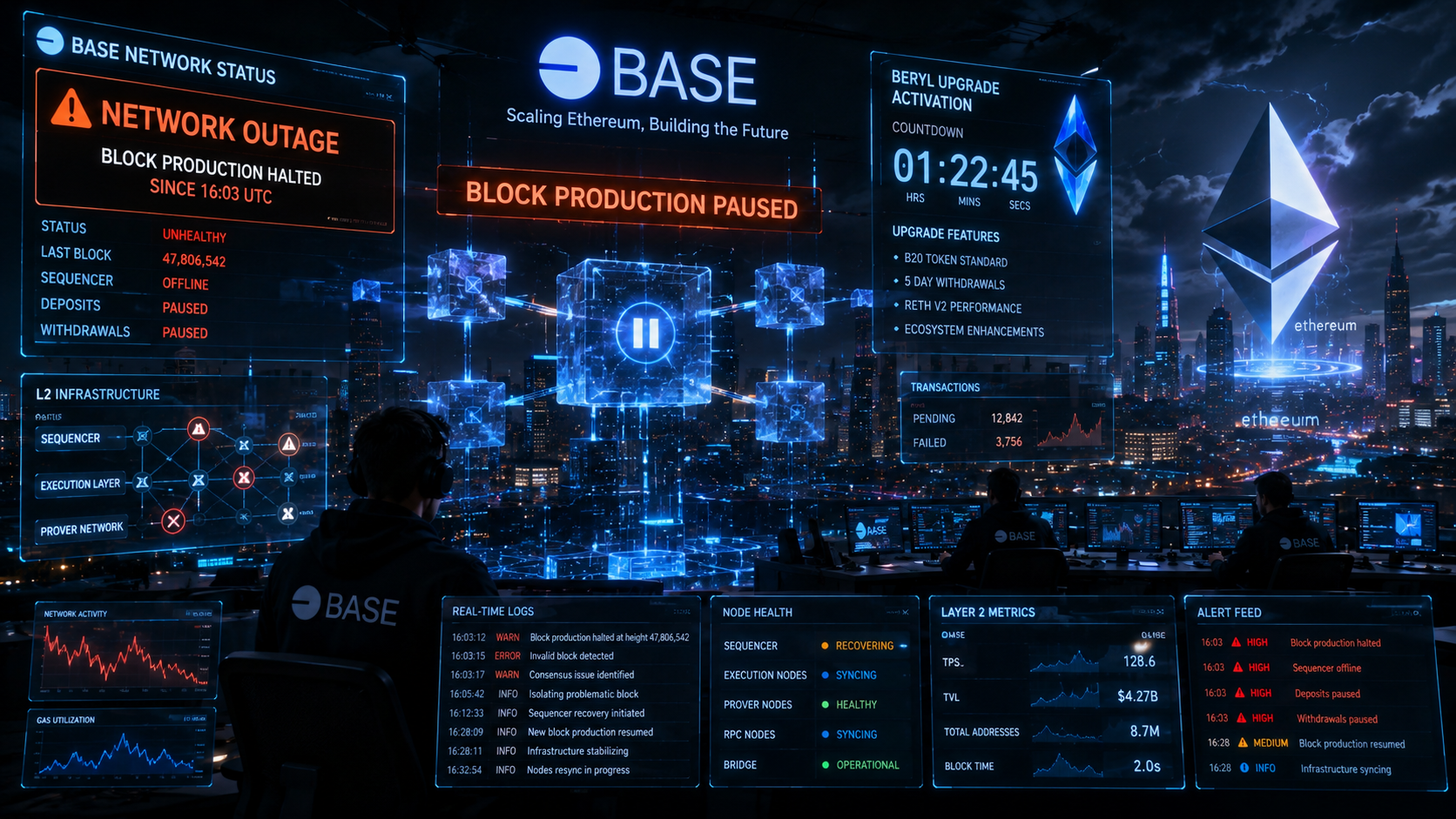
Coinbase-backed Layer 2 network Base experienced a temporary disruption on Wednesday after block production stalled for approximately one hour, briefly impacting deposits, withdrawals, and transaction processing across the ecosystem.
The incident occurred just hours before the highly anticipated Beryl upgrade, raising concerns about network reliability while also highlighting the operational challenges facing rapidly growing Ethereum scaling solutions.
Despite the outage, Base developers confirmed that user funds remained secure and normal network operations have since resumed.
What Happened?
According to Base’s official status updates, the disruption began around 16:03 UTC when the network reported unhealthy block production.
Engineers traced the issue to a consensus-related problem involving a faulty block at height 47,806,542, which prevented subsequent blocks from being sequenced correctly.
The network’s centralized sequencer infrastructure allowed the team to quickly isolate the problematic block, restore internal operations, and resume block production later in the day.
Node operators were subsequently instructed to restart their clients to synchronize with the updated chain state.
Funds Remained Safe
Base emphasized that no user funds were at risk during the incident.
Transactions already confirmed before the outage remained unaffected, while pending transactions began processing once block production resumed.
The team reported no chain reorganizations, asset losses, or security breaches, noting that ecosystem infrastructure providers continue to synchronize with the network as normal operations return.
Outage Comes Ahead of Beryl Upgrade
The timing of the disruption attracted significant attention because it occurred shortly before Base’s scheduled Beryl hard fork, one of the network’s most important upgrades to date.
The Beryl upgrade introduces several notable improvements, including:
- B20 native token standard support
- Faster withdrawal times, reduced from seven days to five days
- Performance improvements powered by Reth V2
- Enhanced support for stablecoins and tokenized real-world assets (RWAs)
- Infrastructure upgrades designed to improve scalability and efficiency
Despite the temporary outage, Base indicated that the upgrade remains on track.
Centralization Debate Returns
The incident has reignited discussions around the trade-offs of Base’s current architecture.
Like many optimistic rollups, Base relies on a centralized sequencer to order transactions before they are finalized on Ethereum. While this model enables faster recovery and operational flexibility, critics argue it creates potential single points of failure.
Supporters counter that temporary centralization has allowed networks like Base to scale quickly while gradually working toward greater decentralization.
The swift resolution of the outage may strengthen arguments that centralized sequencers can provide operational advantages during unexpected disruptions.
Base Continues to Grow
Despite occasional technical challenges, Base has emerged as one of Ethereum’s fastest-growing Layer 2 networks.
The ecosystem has attracted billions of dollars in total value locked (TVL) and supports a growing range of applications across decentralized finance, payments, gaming, social protocols, and AI-powered applications.
Major protocols operating on Base include Aerodrome, Aave, and numerous on-chain financial services platforms.
The network’s close association with Coinbase has also helped drive institutional and retail adoption.
What’s Next?
Base has committed to publishing a full post-mortem detailing the root cause of the outage and any preventative measures planned for the future.
Meanwhile, developers and users will be watching closely as the Beryl upgrade rolls out across the network.
If successful, the upgrade could further strengthen Base’s position among leading Ethereum Layer 2 solutions and reinforce its ambitions to become a foundational platform for on-chain finance and mainstream blockchain adoption.
While short-lived outages remain a concern for blockchain networks, industry observers note that resilience is often measured not by avoiding disruptions entirely, but by how quickly systems recover when challenges arise.