

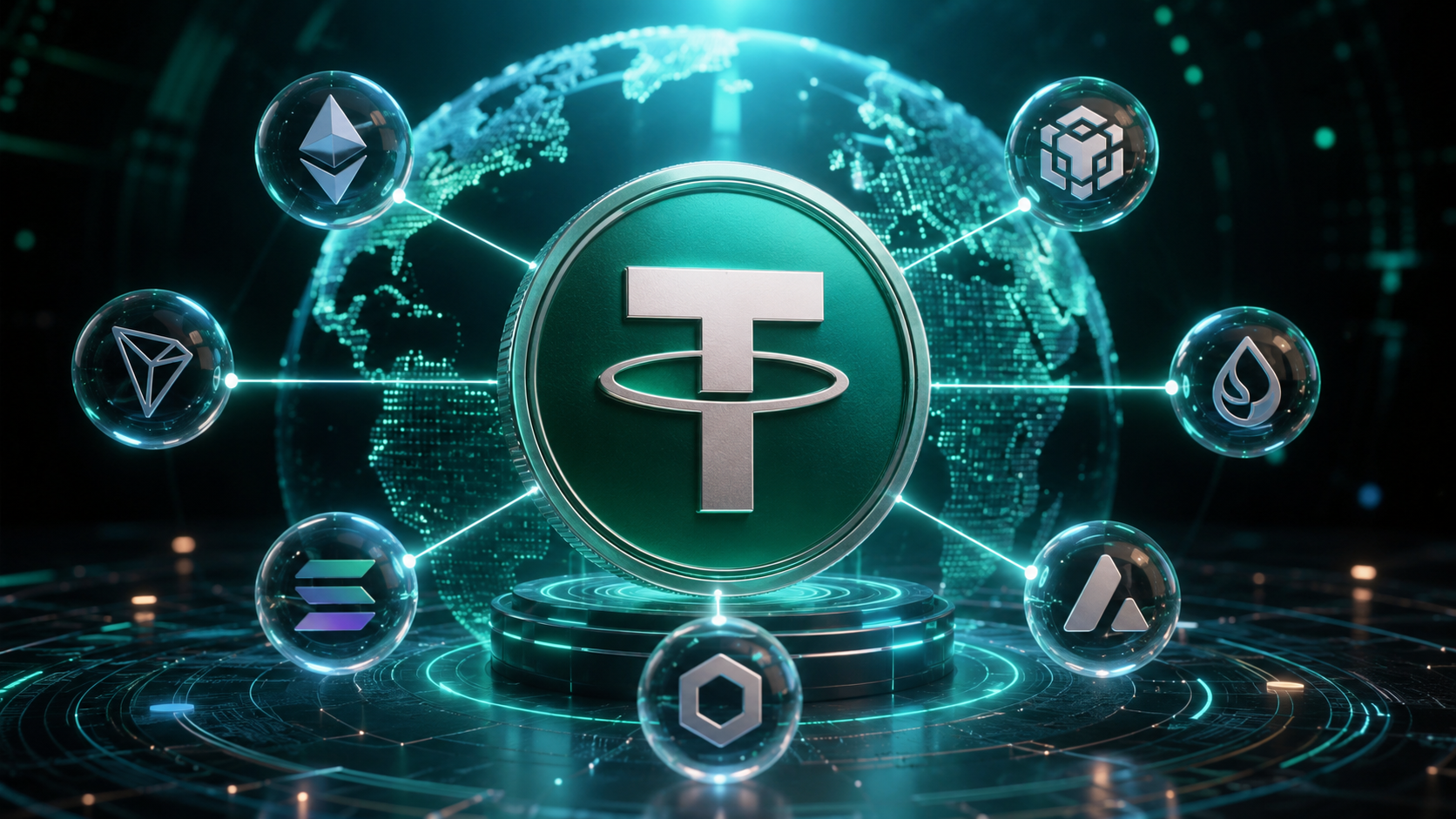
Tether has rejected reports that it is developing its own blockchain, with CEO Paolo Ardoino stating that the company is not building a blockchain and has no plans to launch one. The clarification comes after recent industry discussions placed Tether among companies allegedly exploring dedicated “stablechains” designed to make stablecoin payments faster and cheaper.
The statement is significant because Tether operates the world’s largest stablecoin, USDT, which already runs across multiple independent blockchain networks. Tether’s official documentation lists support for networks including Ethereum, Tron, Solana, TON, Avalanche, BNB Smart Chain, Aptos, Celo, Kaia, Tezos and others. This multi chain approach allows USDT to reach users across different blockchain ecosystems without requiring Tether to operate a proprietary network.
Tether Rejects Stablechain Claims
The latest clarification followed research and market commentary that grouped Tether with companies such as Stripe and Circle in a broader push toward dedicated stablecoin payment networks. The reports suggested that major stablecoin companies could be moving toward owning specialized blockchain infrastructure for digital-dollar payments. Ardoino directly rejected the idea that Tether belongs in that category, saying the company is neither building its own blockchain nor planning to launch one.
The distinction matters because a proprietary blockchain would give Tether direct control over transaction infrastructure, network fees, block production and technical upgrades. Instead, Tether continues to use existing blockchain networks as distribution and settlement rails for USDT. Its official supported protocol documentation confirms that Tether tokens exist across multiple blockchains and that the company continues to support ecosystems based on developer activity, scalability and user demand.
Tether’s strategy also differs from the approach taken by some newer stablecoin focused networks. CoinMarketCap, for example, describes Stable as a dedicated Layer 1 designed around stablecoin payments, with USDT and USDT0 used as transaction fuel while a separate STABLE token handles network security and governance. That type of infrastructure can create a specialized payment environment, but it should not be confused with a Tether operated blockchain.
USDT Remains a Multi Chain Stablecoin
Tether’s decision to maintain a multi chain model gives USDT broad access to established blockchain ecosystems. Users can transact with USDT through networks such as Ethereum, Tron, Solana and TON, while exchanges, wallets and decentralized applications can integrate the stablecoin through supported protocols. This model lets Tether expand USDT liquidity without forcing users into a single proprietary network.
Tether has also demonstrated that it is willing to adjust its blockchain strategy based on adoption. In 2025, the company announced changes involving several legacy networks, including Omni Layer, Bitcoin Cash SLP, Kusama, EOS and Algorand, as it shifted resources toward ecosystems with stronger developer activity, scalability and user demand. The move highlights a strategy centered on supporting useful blockchain infrastructure rather than owning every part of the technology stack.
The company is still expanding its broader digital-asset infrastructure. In February 2026, Tether announced an investment in t0 network, a payment platform designed to use USD₮ as settlement infrastructure for licensed financial institutions and cross-border transactions. Tether has also continued exploring tokenization and digital asset infrastructure through partnerships such as its July 2026 memorandum with the Nairobi Securities Exchange.
What Tether’s Blockchain Strategy Means
The denial does not mean Tether is stepping away from blockchain technology. Instead, it reinforces the company’s existing strategy of making USDT available across multiple networks while investing in payment infrastructure, tokenization, wallets, artificial intelligence and other digital-asset technologies. Tether’s recent initiatives show that the company can expand its ecosystem without creating a proprietary Layer 1 blockchain.
For the stablecoin market, the announcement also highlights an important infrastructure debate. Companies increasingly view stablecoins as payment tools rather than simply crypto trading assets, creating demand for faster and cheaper settlement networks. Some firms may choose to build dedicated blockchains, while Tether appears focused on keeping USDT portable across existing networks and investing in infrastructure around the stablecoin itself.
For USDT users, the immediate takeaway is straightforward: there is currently no announced Tether blockchain to migrate to. USDT remains a multi chain asset, and Tether’s official documentation continues to identify numerous supported blockchain protocols. Unless the company changes its position in the future, the world’s largest stablecoin will continue operating across external blockchain networks rather than on a dedicated Tether chain.