
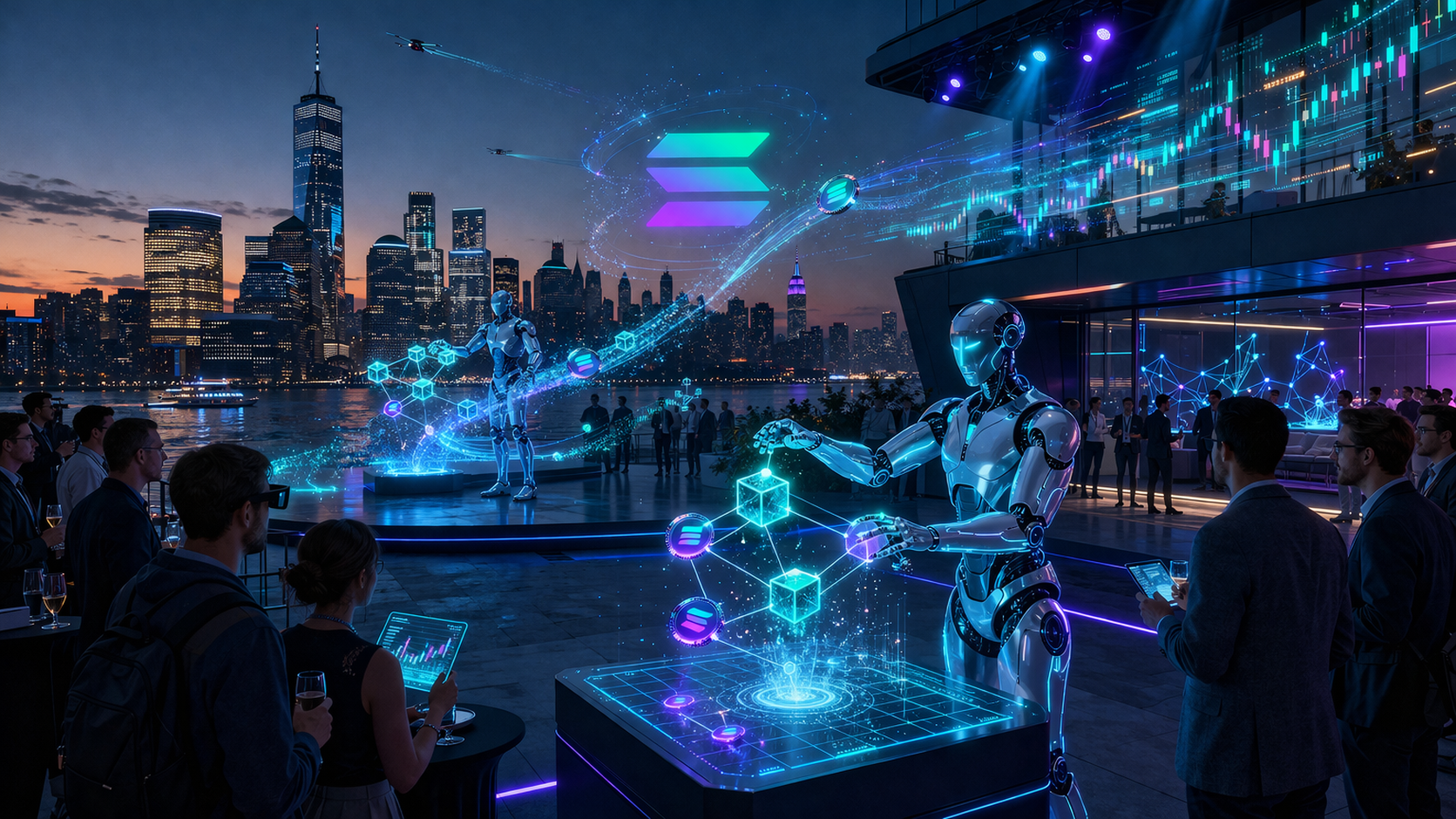
The Solana Foundation has set out an ambitious vision for the future of artificial intelligence, declaring its network a key foundation for what it calls the emerging “agentic internet,” during a high-profile appearance in New York this week.
Speaking alongside developers and ecosystem leaders, representatives of the Solana ecosystem outlined how autonomous AI agents, capable of executing transactions, interacting with applications, and coordinating with one another, could reshape both digital services and financial systems.
The message was clear. Solana is not just aiming to support AI innovation, but to underpin it.
A Blockchain for Autonomous Systems
At the center of the discussion was the concept of AI agents operating independently on-chain. These systems, often described as software entities capable of decision-making and economic activity, require infrastructure that can handle high-speed, low-cost transactions at scale.
Solana’s architecture, known for its throughput and minimal fees, was repeatedly positioned as uniquely suited to this role.
“AI agents need markets, and markets need infrastructure that can operate in real time,” one foundation representative noted during the session, emphasizing that traditional systems lack the efficiency required for machine-driven economies.
The framing marks a shift from earlier blockchain narratives focused on decentralized finance or NFTs, toward a future where machines themselves become primary users of the network.
New York Becomes a Stage for AI and Crypto Convergence
The New York event, attended by a mix of crypto founders, AI developers, and institutional observers, reflected growing interest in the intersection of blockchain and artificial intelligence.
Panels and demonstrations showcased early-stage applications where AI agents perform tasks such as trading digital assets, managing on-chain identities, and coordinating services without direct human input.
The convergence is still in its early phases, but momentum is building. Developers highlighted how composability, a core feature of Solana’s design, allows AI systems to interact seamlessly with multiple protocols, creating more complex and capable applications.
From Users to Agents
A recurring theme throughout the conference was the idea that the internet’s next evolution may not be driven primarily by human users, but by networks of autonomous agents acting on their behalf.
This “agentic internet” would see AI systems handling everything from financial transactions to content distribution, raising both opportunities and profound questions around control, accountability, and trust.
For Solana, the opportunity lies in becoming the transaction layer for this new paradigm.
“Blockchains give agents the ability to own assets, transact, and verify actions without centralized intermediaries,” a developer said during a live demo, illustrating how AI-driven wallets could operate continuously and globally.
Challenges Beneath the Optimism
Despite the forward-looking narrative, significant hurdles remain. Questions around security, misuse, and regulatory oversight were raised throughout the event, particularly as autonomous systems gain the ability to control financial resources.
There is also the broader issue of whether current blockchain infrastructure, including Solana, can maintain reliability under the demands of machine-scale activity.
Still, the tone in New York was one of cautious confidence. The presence of institutional participants suggests that interest in AI-blockchain convergence is extending beyond experimental projects into more serious investment and development cycles.
A Strategic Bet on the Future
By aligning itself with the rise of AI agents, the Solana Foundation is making a calculated bet on where the internet is heading next.
If autonomous systems become a dominant force online, the infrastructure supporting them could prove as critical as the cloud platforms that power today’s digital economy.
For now, Solana is positioning itself early, aiming to ensure that when the agentic internet arrives, it runs on its rails.