

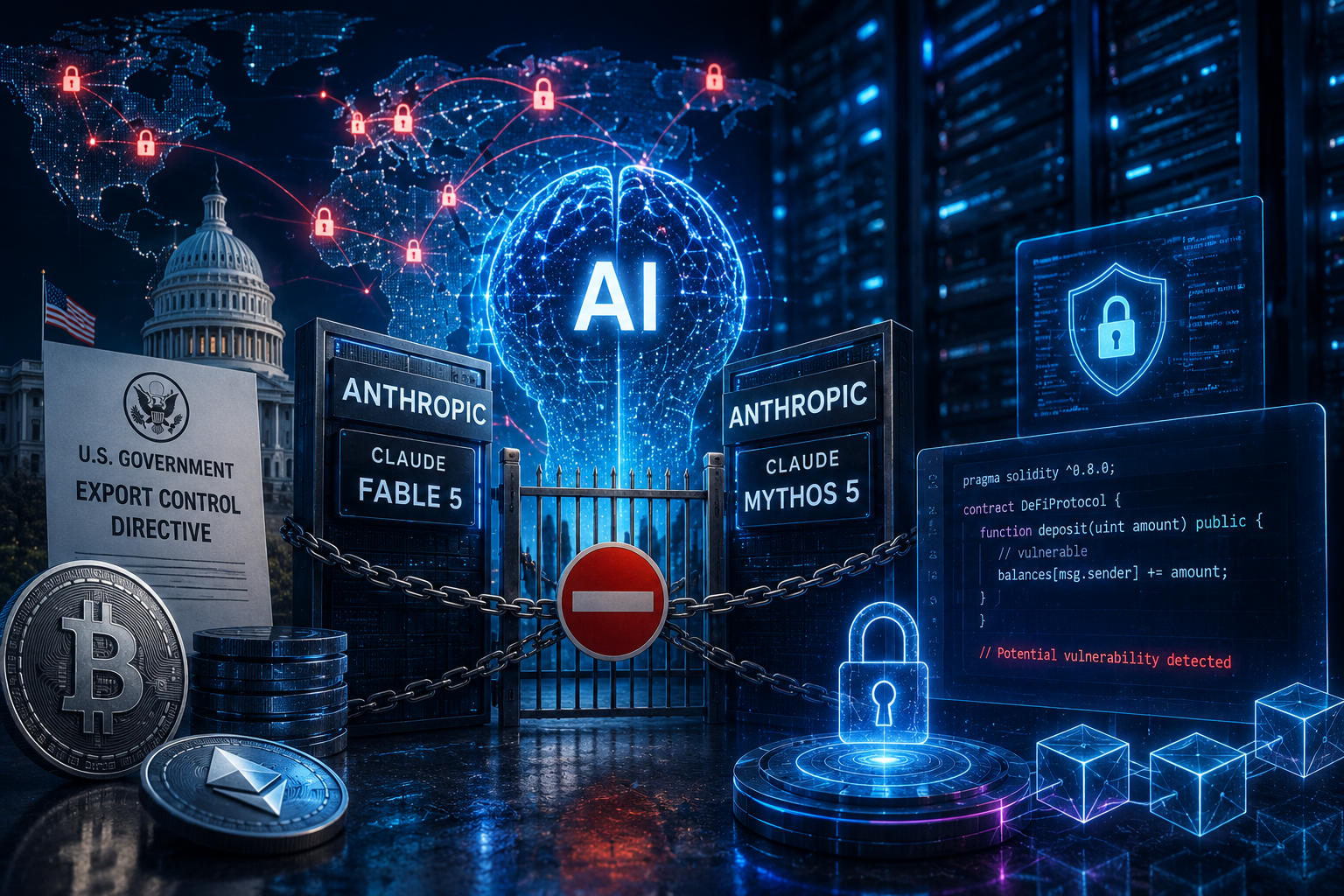
Artificial intelligence firm Anthropic has reportedly suspended access to two of its most advanced AI models following regulatory pressure tied to U.S. export control requirements, highlighting growing tensions between national security concerns and the rapid adoption of AI across industries, including crypto and Web3.
The move comes just days after the release of the company’s latest frontier AI systems, which were designed to deliver enhanced reasoning, coding, and cybersecurity capabilities.
According to reports, U.S. authorities raised concerns that the models could potentially be leveraged for offensive cybersecurity activities, prompting restrictions that affected access beyond the United States. Anthropic has stated that it is complying with government requirements while working to restore availability through approved channels.
AI Regulation Reaches a New Stage
The development marks one of the clearest examples yet of governments treating advanced AI systems as strategic technologies subject to national security oversight.
As AI capabilities continue to improve, regulators are increasingly focused on models that can assist with vulnerability discovery, exploit development, and other dual-use applications that may serve both defensive and offensive purposes.
The debate mirrors broader conversations already familiar to the crypto industry, where privacy tools, encryption technologies, and decentralized infrastructure have frequently faced regulatory scrutiny despite legitimate use cases.
Why Crypto Builders Are Paying Attention
For blockchain developers, the implications extend beyond the AI sector.
Advanced language models are becoming an integral part of smart contract development, code review, protocol auditing, bug detection, and security research. Many crypto teams now rely on AI-powered tools to accelerate development cycles and identify vulnerabilities before deployment.
The prospect of restricted access to cutting-edge models raises concerns about concentration risk, particularly if critical security tooling becomes dependent on a small number of providers operating under increasingly complex regulatory frameworks.
Security researchers have also demonstrated that sophisticated AI systems can identify weaknesses in blockchain code, making them valuable tools for both protocol defense and, potentially, malicious actors.
A Double-Edged Sword for Web3 Security
The intersection of AI and crypto security continues to present both opportunities and challenges.
On one hand, more capable AI systems could dramatically improve smart contract auditing, helping developers uncover vulnerabilities before exploits occur. On the other hand, regulators worry that the same capabilities could be used to accelerate cyberattacks or automate vulnerability discovery at scale.
This dual-use nature has become a recurring theme in policy discussions surrounding emerging technologies.
For DeFi protocols, infrastructure providers, and blockchain developers, the latest developments reinforce the importance of maintaining diverse security workflows rather than relying on a single AI platform.
Regulatory Pressure Expands
The reported restrictions arrive as governments worldwide increase oversight of advanced AI development, particularly models capable of cybersecurity research, autonomous task execution, and high-level code generation.
Industry observers note that the trend could have long-term implications for sectors where AI and blockchain technologies increasingly overlap, including autonomous trading systems, agent-based finance, smart contract development, and decentralized security monitoring.
As AI becomes a core component of Web3 infrastructure, regulatory actions targeting frontier models may have ripple effects far beyond the technology sector.
Looking Ahead
While crypto markets showed little immediate reaction to the reports, the episode underscores a broader reality: the future of blockchain innovation may become increasingly linked to developments in artificial intelligence policy.
For crypto builders, the key takeaway is clear. As AI capabilities advance and regulations evolve, access to critical development and security tools may become as strategically important as access to computing power and blockchain infrastructure.
The convergence of AI and crypto is accelerating, but so is government scrutiny. The balance between innovation, security, and regulation is likely to define the next phase of both industries.