

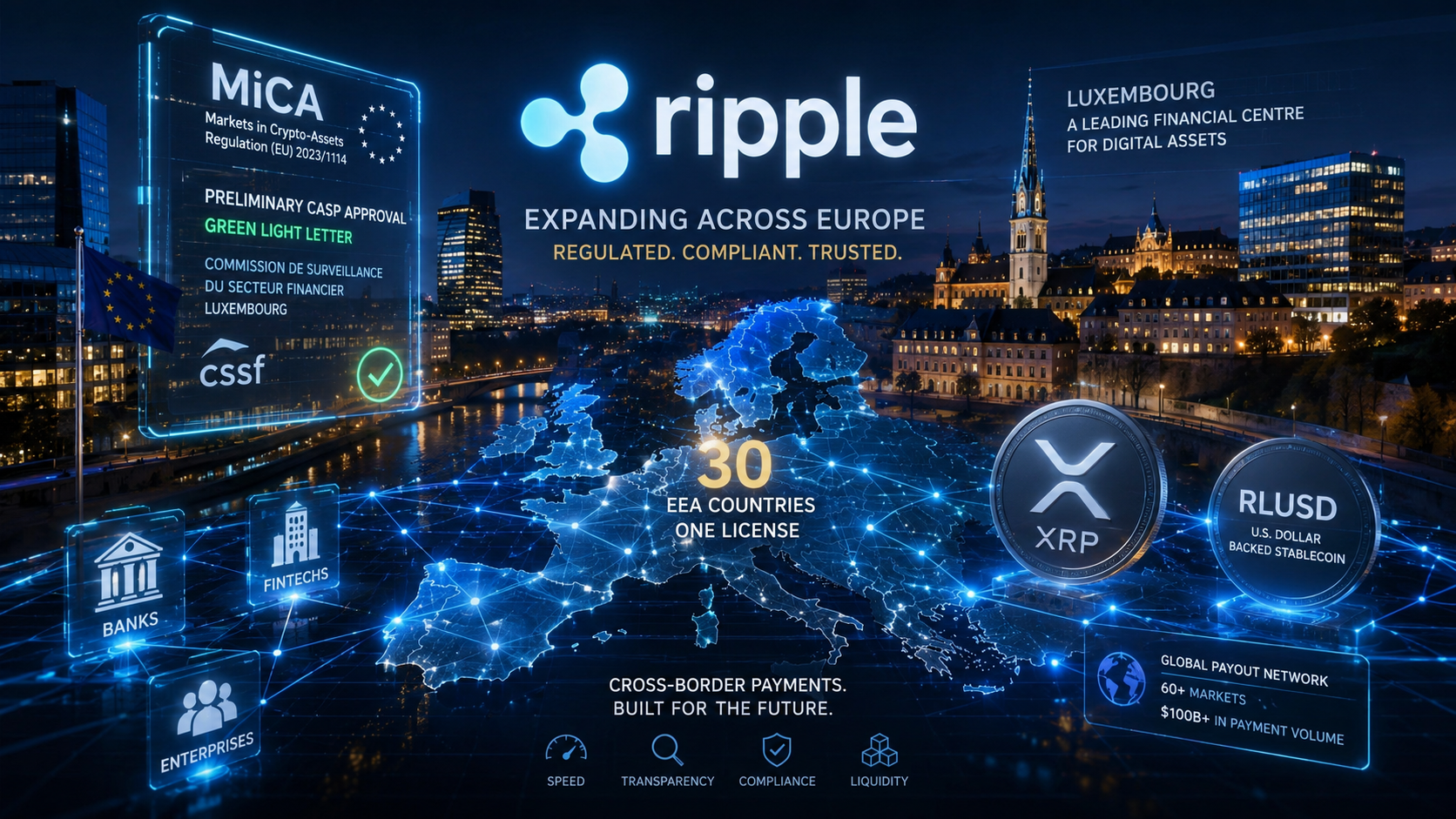
Ripple has taken a major step toward expanding its presence across Europe after receiving preliminary approval for a Crypto-Asset Service Provider (CASP) license in Luxembourg under the European Union’s landmark Markets in Crypto-Assets (MiCA) framework.
The approval, granted by Luxembourg’s Commission de Surveillance du Secteur Financier (CSSF) in the form of a “Green Light Letter,” positions Ripple to bring its institutional payment services to the entire European Economic Area (EEA) once the remaining licensing requirements are fulfilled.
If finalized, the authorization would enable Ripple to operate across 30 European countries under a single regulatory framework, strengthening its role as one of the crypto industry’s most regulated infrastructure providers.
Ripple Moves Closer to Pan-European Operations
The preliminary CASP approval builds on Ripple’s growing regulatory momentum in Europe.
Earlier this year, the company secured a full Electronic Money Institution (EMI) license in Luxembourg, allowing it to offer regulated payment services throughout the region.
Combined, the EMI and CASP authorizations would allow banks, fintech firms, and enterprise clients to access crypto-enabled payment services through a unified, compliant infrastructure.
The move is expected to accelerate Ripple’s ambitions in cross-border payments, treasury management, and institutional digital asset adoption throughout Europe.
Ripple Payments Set for EEA Expansion
Ripple said the approval clears the path for Ripple Payments to expand throughout the European Economic Area under MiCA regulations.
The platform has already processed more than $100 billion in transaction volume globally, supporting clients across more than 60 markets worldwide.
With MiCA passporting rights, eligible businesses across Europe could gain access to Ripple’s network for:
- Cross-border settlements
- Global payout services
- Crypto-enabled treasury operations
- Stablecoin-based payments
- Institutional liquidity solutions
The expansion reflects growing demand from traditional financial institutions seeking compliant access to blockchain-based payment infrastructure.
RLUSD Could Benefit from Europe’s Regulatory Clarity
Ripple’s regulatory progress may also strengthen the position of RLUSD, the company’s U.S. dollar-backed stablecoin.
Already regulated by the New York Department of Financial Services (NYDFS), RLUSD is increasingly being positioned as a bridge asset for enterprise use cases, including remittances, real-time settlements, and international treasury operations.
As stablecoin regulation becomes clearer across Europe, Ripple could leverage RLUSD to serve institutions looking for compliant digital payment solutions.
Luxembourg Emerges as a Crypto Hub
Ripple executives praised Luxembourg’s approach to digital asset regulation, describing the country as one of Europe’s leading financial centers.
The country’s balanced regulatory framework has attracted a growing number of blockchain and fintech companies seeking access to the broader European market.
The timing is particularly significant, with MiCA’s transitional period for legacy Virtual Asset Service Providers nearing its conclusion. Companies that proactively secure authorization stand to benefit from streamlined market access across the EU.
Ripple’s Global Regulatory Footprint Continues to Grow
With the latest approval, Ripple now holds more than 75 regulatory licenses and registrations worldwide, underscoring its strategy of prioritizing compliance as a competitive advantage.
The company has expanded its licensing efforts across major jurisdictions, including the United Kingdom, the United States, the Middle East, and Asia-Pacific, as institutional interest in blockchain infrastructure continues to grow.
Analysts view Ripple’s regulatory progress as a sign of the maturing digital asset industry, where compliance and trust are becoming increasingly important for enterprise adoption.
What This Means for XRP
While the approval does not directly impact XRP’s utility or token economics, many market participants view it as a positive development for the broader Ripple ecosystem.
Greater institutional access to Ripple’s infrastructure could increase awareness of XRP Ledger technologies and reinforce Ripple’s position within the evolving global payments landscape.
As Europe embraces MiCA and regulated digital asset services, Ripple appears well-positioned to capitalize on the next phase of institutional blockchain adoption.