

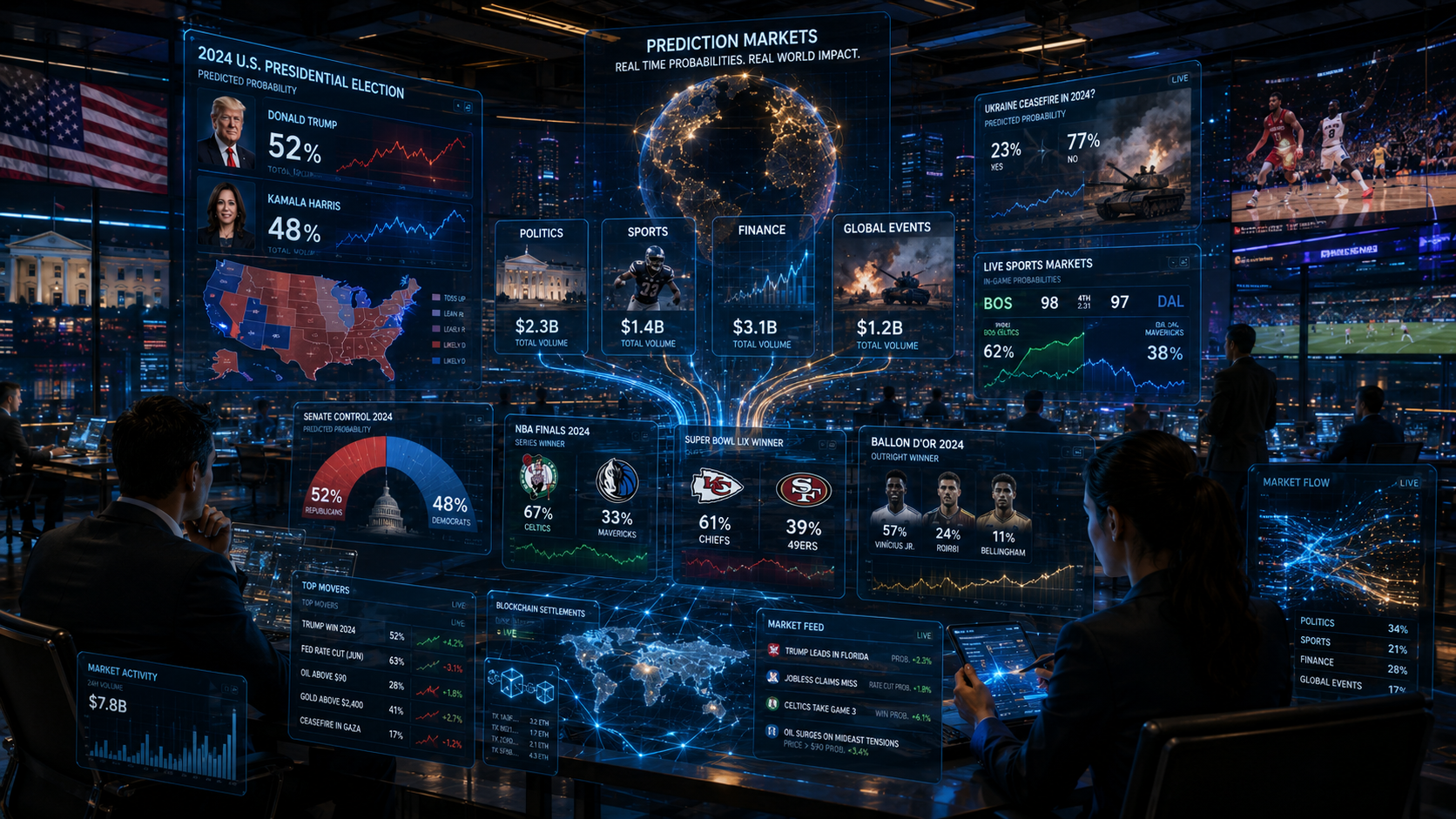
For most of its existence, the cryptocurrency industry has been searching for its killer app, and prediction markets may finally be emerging as a strong contender. Bitcoin introduced digital money without banks. Ethereum brought smart contracts. Decentralized finance promised to rebuild finance from the ground up. NFTs briefly persuaded millions that profile pictures could double as investment vehicles. Then came blockchain gaming, the metaverse, tokenized real-world assets, decentralized social media, and enough buzzwords to keep crypto conference panels fully booked for years.
Yet despite billions of dollars in investment and relentless innovation, crypto has often struggled with a simple challenge. Many of its most celebrated products have primarily appealed to people who were already deeply invested in the industry. Mainstream adoption has remained frustratingly elusive.
Prediction markets, however, may be changing that.
What was once considered a niche corner of the blockchain ecosystem is rapidly evolving into one of crypto’s most compelling and practical use cases. Platforms such as Polymarket have attracted growing attention from traders, analysts, journalists, and everyday users looking for insights into future events. New competitors continue to emerge, while blockchain ecosystems increasingly develop their own prediction-market offerings. Whether forecasting elections, sporting events, financial markets, or major global developments, prediction markets are transforming speculation into something far more useful. In the process, they may be becoming exactly what crypto has long been searching for: a product people genuinely want to use.
Betting On The Future
At their core, prediction markets are remarkably simple. Participants buy and sell positions based on the outcome of future events. A market might ask whether Bitcoin will finish the year above a certain price, whether a political candidate will win an election, or whether a company will launch a product before a specific deadline.
Each market functions as a collective forecast. If a contract trading at 80 cents pays out $1 when an event occurs, the market is effectively assigning an 80% probability to that outcome. As new information emerges, prices adjust in real time, creating a constantly evolving snapshot of collective expectations. Unlike traditional polls or expert opinions, prediction markets include one crucial difference: participants have money at stake.
That detail tends to focus the mind. People are often happy to make bold predictions on social media, in group chats, or over dinner. Confidence levels can change surprisingly quickly when being wrong comes with a financial consequence. It turns out uncertainty becomes much more interesting when your wallet joins the discussion.
While prediction markets existed long before blockchain technology, earlier versions often struggled with practical limitations. Regulatory hurdles, geographic restrictions, payment friction, operational complexity, and liquidity challenges frequently limited their growth. Blockchain networks solve many of those problems by providing global access, transparent settlement, continuous operation, and programmable infrastructure capable of supporting thousands of markets simultaneously. Instead of relying on traditional financial systems, users can participate directly through digital assets and smart contracts.
The result is a platform that is often more accessible, transparent, and efficient than its predecessors. Crypto also contributes something equally important: a ready-made audience. Speculation has never been an unfamiliar concept within digital asset markets. A community comfortable assessing probabilities, analyzing information, and managing risk naturally overlaps with the type of users most likely to engage with prediction markets. For perhaps the first time, blockchain technology and a consumer-facing product feel perfectly aligned.
More Than Just Gambling
One reason prediction markets are attracting growing attention is that they may be considerably more useful than they initially appear. Critics often dismiss them as little more than decentralized gambling platforms wrapped in blockchain branding. On the surface, the comparison seems reasonable. Participants are placing money on uncertain outcomes and hoping to be correct.
Supporters see something very different. They view prediction markets as information markets. Rather than simply creating entertainment, these platforms aggregate knowledge from thousands of participants and convert it into measurable probabilities. Every trade reflects a judgment about available information, and market prices adjust as new evidence enters the system.
The idea itself is not new. Economists have argued for decades that markets can sometimes outperform polls, surveys, and even expert forecasts because they reward participants for being right rather than merely sounding convincing. Prediction markets are far from perfect. They can be wrong, occasionally in dramatic fashion. Yet they often provide fascinating real-time insights into how large groups of people collectively evaluate future events.
In other words, they are not asking what people think will happen. They are asking what people are willing to bet will happen. Those are often very different answers. That distinction helps explain why prediction markets have become increasingly valuable to analysts, researchers, traders, and journalists seeking signals about future developments.
Crypto’s Most Practical Use Case Yet
Much of the sector’s recent growth has been driven by real-world events. Political elections have generated enormous trading volumes in recent years. Sporting events continue attracting participants worldwide. Financial markets have become another major category, with users forecasting everything from interest-rate decisions and inflation data to Bitcoin prices and corporate earnings.
Increasingly, prediction markets are becoming a destination for understanding sentiment. A growing number of analysts, journalists, and researchers monitor these platforms because they provide a constantly updated view of collective expectations. In some cases, prediction-market odds now appear alongside polling data and expert forecasts in mainstream media coverage.
That represents a significant shift. For years, many blockchain applications struggled to demonstrate meaningful value beyond crypto-native circles. Prediction markets are beginning to attract people who may have little interest in blockchain technology itself. They simply want better information.
Of course, challenges remain. Regulation continues to be one of the biggest uncertainties facing the sector. Different jurisdictions take very different approaches to event-based contracts and speculative markets, creating an uneven legal landscape for operators and users alike. Liquidity can also present obstacles, particularly in smaller markets where participation remains limited. There is also the risk of manipulation, misinformation, and coordinated behavior. Like any market, prediction platforms are only as reliable as the information reflected in their prices.
None of these challenges are insurmountable, but they highlight an important reality: prediction markets remain an evolving technology rather than a finished product.
Looking Ahead
Still, crypto’s greatest successes have often emerged from unexpected places. Few people predicted that stablecoins would become one of blockchain’s most important innovations. Almost nobody foresaw tokenized dollars processing trillions of dollars in annual transaction volume. The industry’s most transformative products often looked surprisingly ordinary in their early days.
Prediction markets may be following a similar path. They combine incentives, information, speculation, and global accessibility into a product uniquely suited to blockchain networks. More importantly, they solve a problem that exists far beyond the crypto industry itself: helping people navigate uncertainty.
The future remains impossible to predict. Ironically, prediction markets may be one of the best tools we have for trying.