

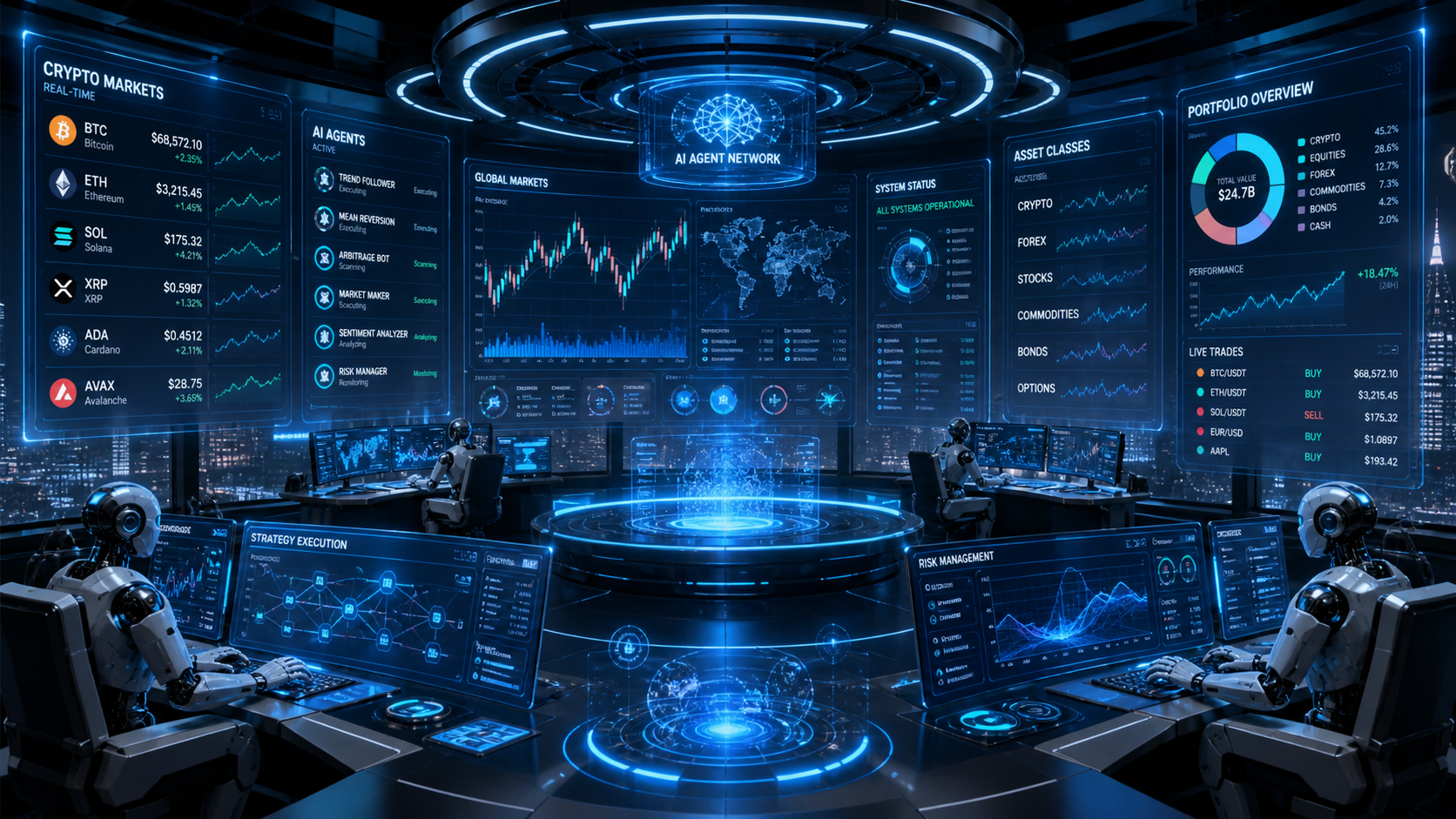
Kuvi.ai has announced the launch of its native utility token, KUVI, alongside a Token Generation Event set for May 1, 2026. The token will debut on MEXC and PancakeSwap, marking a significant step in what the company calls a new “strategy layer” of financial infrastructure.
The Toronto-based firm is positioning itself at the forefront of a structural shift in finance, moving from traditional Assets Under Management to what it describes as Assets Under Autonomy.
Replacing Institutional Strategy With Code
Financial systems have historically evolved in distinct layers, from capital pooling through joint-stock companies to digital execution via electronic trading, and later to programmable ownership through blockchain technology. However, financial strategy itself has remained largely controlled by institutions such as banks and hedge funds.
Kuvi aims to change that dynamic by introducing software-based strategy execution.
Built on its Agentic Finance Operating System, the platform allows users to convert financial goals into programmable strategies. These strategies operate continuously, analyzing signals, managing risk, and deploying capital without manual intervention.
At the core of this system are “daemons,” modular automation processes that monitor conditions and execute trades when predefined criteria are met. This design transforms strategy from a human-driven function into an automated infrastructure layer.
Chief Executive Dylan Dewdney framed the development as a natural progression in financial technology. He stated that while Bitcoin made money programmable and Ethereum made finance programmable, Kuvi is focused on making strategy programmable.
Toward Autonomous Capital Deployment
Kuvi’s architecture enables strategies to pull data from multiple sources, including market feeds, prediction platforms, and real-time sentiment signals from social networks. This allows near-instant responses to market changes, reducing the delay between signal detection and execution.
The system supports a wide range of trading approaches, including momentum strategies, arbitrage, event-driven trading, and automated portfolio management. Users can assemble these strategies from reusable components, allowing them to adapt as market conditions evolve.
The company is also exploring integrations with major wallet providers and centralized exchanges. These partnerships could allow Kuvi-based strategies to execute across multiple financial platforms while users retain custody of their assets.
As tokenization expands to include equities, commodities, and other traditional assets, Kuvi sees a growing opportunity. Programmable access to these markets could allow strategies to operate seamlessly across asset classes, creating a unified execution layer for global finance.
This shift redefines how capital flows. In traditional finance, investors rely on intermediaries to manage funds. In Kuvi’s model, capital moves directly through programmable strategies, turning it into an active, continuously operating resource.
A Symbolic Launch Moment
The company has deliberately aligned its Token Generation Event with International Workers’ Day. The date reflects a broader theme of economic participation and access, echoing the crypto industry’s push toward decentralization.
Kuvi’s leadership views this as part of a larger movement to expand financial control beyond institutions and into the hands of individuals. By enabling users to deploy capital autonomously, the platform aims to increase participation in global markets.
Earlier developments also include the acquisition of Altura by Kuvi’s parent company, Agentonomics. The platform is expected to pivot toward a new category described as agentic gaming, further expanding the ecosystem’s scope.
Kuvi.ai positions itself as a pioneer in what it calls Agentic Finance, where intent-driven systems translate user goals into automated financial strategies. The company believes this model lays the foundation for a future defined by autonomous capital management.