

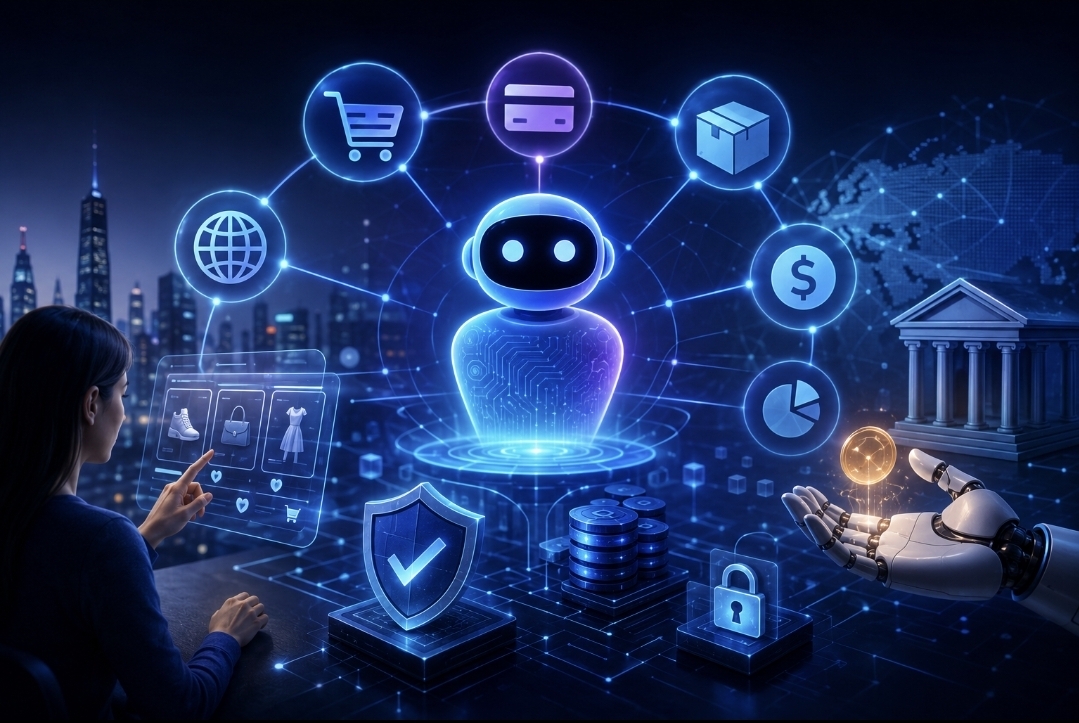
This is an Opinion Piece by Chandler Fang, founder of t54. The views & opinions expressed in this article do not necessarily reflect those of Global Crypto.
For the past two years, I’ve watched the conversation around agentic commerce completely transform. Back in 2024, when people talked about the idea of an “agent economy,” most reactions were rooted in skepticism. The common response was essentially: why would anyone trust AI agents with financial transactions? At the time, the idea of autonomous software buying products, managing treasury operations, or executing trades felt highly theoretical to most businesses and consumers alike.
That skepticism made sense. Financial infrastructure depends on trust, accountability, and security. The idea of autonomous systems interacting directly with payment rails naturally raised concerns around fraud, compliance, identity verification, and operational risk. But over the course of 2025 and into 2026, the industry matured much faster than many people expected.
What changed was that agentic commerce stopped being an abstract concept and started becoming operational reality.
Institutional Infrastructure Changed the Conversation
One of the biggest turning points came when major financial and technology companies began introducing standards designed specifically for AI-native transactions. Mastercard’s Verifiable Intent framework, developed alongside Google, represented a major signal to the broader market that autonomous commerce was no longer experimental. It showed that large institutions now see AI-driven transactions as an inevitable part of the future digital economy.
At the same time, protocols like x402 started proving that machine-native payments could function at internet scale. Since launch, x402 has already processed more than 150 million transactions, many of which are associated with AI agents interacting with digital products and services autonomously. That level of volume fundamentally shifted industry perception. The conversation stopped being about whether AI agents would participate in commerce. Instead, businesses started focusing on how to support them safely and responsibly.
I think that distinction is important because it reflects where the market truly is today, where we are watching autonomous commerce infrastructure actively emerge in real time.
Commerce Is Becoming Conversational
One of the clearest examples of this shift is happening directly at the consumer level. Klarna recently integrated its shopping and product discovery functionality into ChatGPT through a dedicated app embedded inside OpenAI’s conversational AI platform. Through that integration, users can now discover, compare, and evaluate products across Klarna’s merchant ecosystem entirely through conversational interactions without ever leaving the ChatGPT interface.
That development might seem subtle on the surface, but I think it represents one of the biggest interface changes in the history of e-commerce. Traditional online shopping has always revolved around menus, search bars, filters, tabs, and manual browsing. Agentic commerce changes the interaction model entirely.
Instead of manually navigating storefronts, users increasingly communicate intent through natural language while AI systems manage discovery, filtering, comparison, and eventually execution.
In the near future, it’s easy to imagine consumers instructing AI agents to find flights, negotiate pricing, optimize subscriptions, compare products, manage budgets, or execute purchases automatically based on predefined preferences and constraints. That future is arriving much faster than many people anticipated.
The Biggest Challenge Was Never Capability, It Was Trust
At t54, it became obvious to us very early on that autonomous execution without accountability creates unacceptable levels of risk.
As more companies began launching AI agents capable of trading, managing treasury operations, and making purchases autonomously, they consistently ran into the same underlying issue. Without strong identity systems, embedded guardrails, and verifiable risk controls, businesses simply could not trust autonomous systems with meaningful financial authority.
That realization has become one of the defining themes of the entire industry. For years, most conversations around AI agents focused almost entirely on capability, what agents could do. But very few people were talking seriously about governance, permissions, accountability, or fraud prevention. Once autonomous transactions started moving into real-world production environments, those issues immediately became impossible to ignore.
That’s why I believe trust infrastructure will ultimately become one of the most important layers of the entire agent economy. Businesses need systems capable of verifying identity, monitoring behavior, enforcing permissions, and detecting risk in real time if autonomous commerce is going to scale sustainably.
To date, t54 has already screened more than 20 million transactions, and one of the most validating experiences for us has been watching customers independently arrive at the same conclusion we identified early on. More and more teams are realizing that AI-native commerce only works if trust and accountability are built directly into the infrastructure from day one.
The Next Phase of the Internet Economy
I believe we are now entering the second major phase of agentic commerce. The first phase was about proving that autonomous systems could function. The next phase will focus on interoperability, governance, and scalable trust frameworks that allow millions of AI-driven economic interactions to occur safely every single day.
As these standards mature, AI agents will likely expand far beyond shopping and simple transactions. We’ll increasingly see autonomous systems managing procurement, treasury allocation, subscriptions, logistics coordination, digital services, and highly personalized financial optimization across multiple platforms simultaneously. Humans will still define goals, preferences, and boundaries, but intelligent agents will increasingly handle execution itself.
To me, the broader trend is becoming impossible to ignore: commerce is steadily evolving into a machine-native environment. The companies building identity, verification, and risk infrastructure today may ultimately become as foundational to the next generation of the internet as payment processors were during the rise of e-commerce.
And from where I sit, the strongest signal isn’t the hype cycle. It’s the fact that businesses are no longer asking whether agentic commerce will happen. They’re now asking how quickly they can safely participate in it.
About the author
Chandler Fang is the co-founder of t54. Prior to t54, Chandler was the Lead Product Manager of Payments at Ripple. Before Ripple, as VP of Product Management, he was in charge of JP Morgan’s Cash Flow Forecasting AI product. He also served as a Venture Partner at FoundersX Ventures, investing in DeepTech and FinTech for close to a decade. Chandler holds an MS in Financial Engineering from UC Berkeley Haas. Find out more about Chandler on his LinkedIn profile: https://www.linkedin.com/in/znfang/